A Rainy-Day Rewatch: Follow One Doorway
A rainy-day rewatch focused on one doorway helps you notice who crosses, who waits, and how camera framing quietly shifts the scene’s meaning.
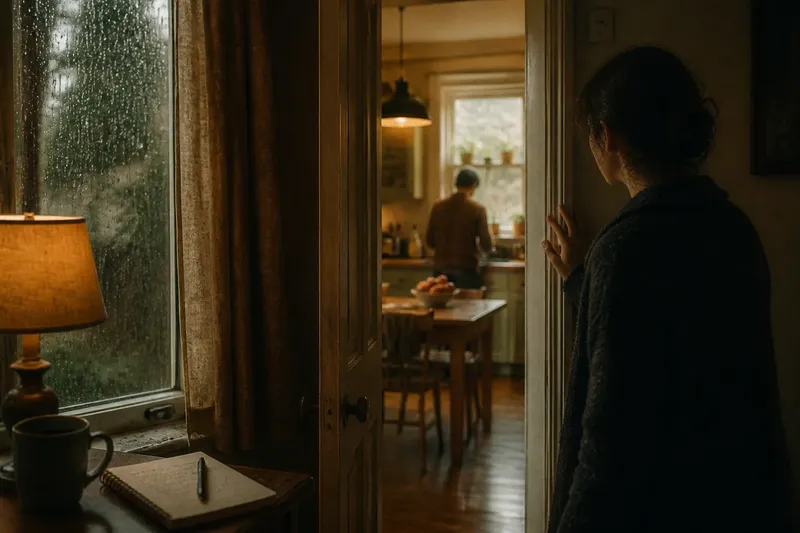
Rain taps the window while a character pauses at a doorway, one hand on the frame and the room beyond still out of reach. For a rainy-day rewatch, follow that single doorway through a film: note who crosses it, who stays outside, and how the camera arranges the threshold around them. The aim is not to retell the plot. It is to watch a familiar place change as people approach it.
Choose a film you already know, preferably one with a house, hotel, school, office, or other setting that gives a doorway more than a passing appearance. Keep a notebook nearby, but do not try to capture every scene. A few precise observations will reveal more than a transcript of every entrance.
Which doorway should you follow?
Pick a doorway that appears, or can be recognized, in several scenes. It might open onto a hallway, separate a kitchen from a dining room, or mark the entrance to a workplace. A door need not dominate the frame; it only needs to be identifiable by details such as its position, color, glass panel, handle, or view beyond it.
Before you press play, write down a neutral description: “the narrow doorway beside the staircase” or “the glass entrance at the back of the lobby.” This is your viewing anchor. Avoid describing it as “the forbidden room’s door” or “the place where the argument happens,” since those labels pull you toward plot and interpretation before you have looked.
If the film has many possible thresholds, choose one that feels ordinary rather than obviously symbolic. An everyday doorway can be revealing precisely because the film treats it as routine: characters may pass through without comment, while the camera quietly changes how much of the next room they can see.
What should you prepare before the film starts?
Set up a small log with four headings: scene or rough position, who crosses, who does not, and framing. Leave room for a final note about what the doorway seems to allow or prevent. You do not need timestamps; a cue such as “after the family meal” is enough to find a moment later.
Keep the entries brief. Record visible actions and composition before assigning meaning: “Mara enters alone; camera stays in the hall; table blocks the lower part of the doorway.” That gives you something concrete to consider later without turning an impression into a fact about the character’s inner life.
Make the viewing comfortable. Set a drink within reach, silence notifications, and choose a seat from which you can see the screen without straining. The room outside the film can be rainy and quiet; the notes should be lighter than a second job.
- Identify the doorway using a stable visual detail.
- Note the person who crosses and the direction of movement.
- Record anyone who waits, watches, or remains on the other side.
- Describe the camera’s position and what the frame includes or hides.
- Mark changes in light, focus, or what is visible beyond the threshold.
How do you track crossings without recapping scenes?
As the film plays, notice each clear encounter with the chosen threshold. A crossing can be a full entrance or exit, but a character may also stop in the opening, lean into the next room, or turn back before passing. Record only the action that matters to the doorway; leave out the conversation unless a line changes how someone uses the space.
Pay attention to direction. Entering and leaving are not interchangeable, and the same person may cross in one direction freely but hesitate in the other. Also note whether a person passes alone, follows someone, leads another person through, or waits for an invitation.
Track non-crossings with equal care. Someone visible through the opening may remain still, be kept outside the room, or watch from a distance. A threshold can organize a scene even when nobody walks through it, much like a chair placed between two people: the object does not speak, but its position shapes what feels easy or awkward.
Use simple, neutral verbs: enters, exits, pauses, looks through, blocks, waits. If a character’s motive seems clear, save that thought for the review after the film. During the first pass, “waits at the threshold” is stronger evidence than “is afraid to go in.”
What changes in the framing?
Now watch how the camera presents the same opening across different moments. Is the doorway centered, pushed to an edge, or partly hidden by a wall or a person? Does the camera stand in the hall, inside the room, or on the far side? Those choices affect whether the viewer seems to share a character’s position or observe from a distance.
Notice what the frame lets you see beyond the threshold. The next room may be fully open, reduced to a narrow slice, softened out of focus, or blocked by furniture. A change in visibility can make the space feel available, uncertain, crowded, or private without any character naming that feeling.
Watch for the camera to hold on an empty doorway after someone leaves, or to cut away before an entrance is complete. Neither choice automatically carries one fixed meaning. Compare it with the film’s other uses of the same doorway: the contrast between a lingering view and a quick cut may be the more useful observation.
Sound can support the visual record, too. A door might click shut, remain open, or let voices from the next room carry into the scene. Note the sound only when it changes your sense of the boundary; do not let a dramatic score substitute for looking at the composition.
How does the doorway shift across the film?
After the viewing, lay your notes beside one another and look for a change in the pattern. Perhaps a character once crossed without pausing but later waits for someone else to move. Perhaps the camera first showed the room beyond clearly, then began withholding it. The useful question is not simply “What does the doorway symbolize?” but “What does the film let people do here now that it did not let them do before?”
Imagine you chose the doorway between a family kitchen and hall. Early in the film, one sibling repeatedly walks through while talking, and the camera stays in the kitchen; later, the sibling pauses in the opening while another person remains out of frame. Your notes could support the observation that the threshold has become a place of hesitation, while leaving open whether the change comes from the characters, the camera, or both.
Separate a pattern from a one-off detail. One blocked view may be a practical composition, but repeated blocking paired with a character waiting outside gives you a more substantial comparison. Still, let the film complicate your reading: a later scene may restore an open view or show a character crossing with ease.
What questions help you read the threshold?
Does entering always mean belonging?
Not necessarily. A character may cross and remain visually isolated, or enter only because someone else has made room. Compare the crossing with who controls the space and where the camera places the newcomer.
What if the doorway appears only briefly?
Record the brief encounter if you can identify the same threshold, but do not force a pattern from a single glimpse. A short appearance can still show who is allowed through and what the framing reveals, then serve as a useful contrast if the doorway returns later.
Should I pause or rewind during the rewatch?
Try watching once without interruption, since a doorway’s meaning can depend on the scene around it. Rewind only after the film ends, and only to clarify a visual detail you genuinely could not read.
What if the film never shows the door opening?
Follow the opening as a threshold even when the door itself stays still or out of view. A character’s position in relation to the frame, the view into the next room, and the camera’s side of the boundary can still shape the scene.
How can you finish with a useful note?
Write a short paragraph after the film using three parts: one recurring crossing, one noticeable framing change, and one question the pattern leaves unresolved. For instance, you might note that a character moves from entering first to waiting outside, while the camera shifts from the room to the hall. Keep the wording tied to what you saw, then say what that arrangement suggests without presenting the suggestion as the only possible reading.
Finally, revisit your original neutral description. Does the doorway still seem like the same ordinary piece of architecture, or has your attention made it feel newly charged? The scene has not changed; your route through it has. That is the small pleasure of a rainy-day rewatch: the doorway becomes a quiet marker of who can approach, who gets to pass, and how long the film asks you to wait with them.
For the next rainy-day rewatch, choose a different doorway rather than trying to track every threshold at once. The focus on one opening keeps the notes readable and gives the film room to surprise you. A rainy-day rewatch works best when the record stays modest and the looking stays attentive.