When a Film Repeats an Image, Notice What Has Changed
Track a repeated image in a film by noting its first appearance, later variations and final context, so interpretation stays grounded in what’s on screen.
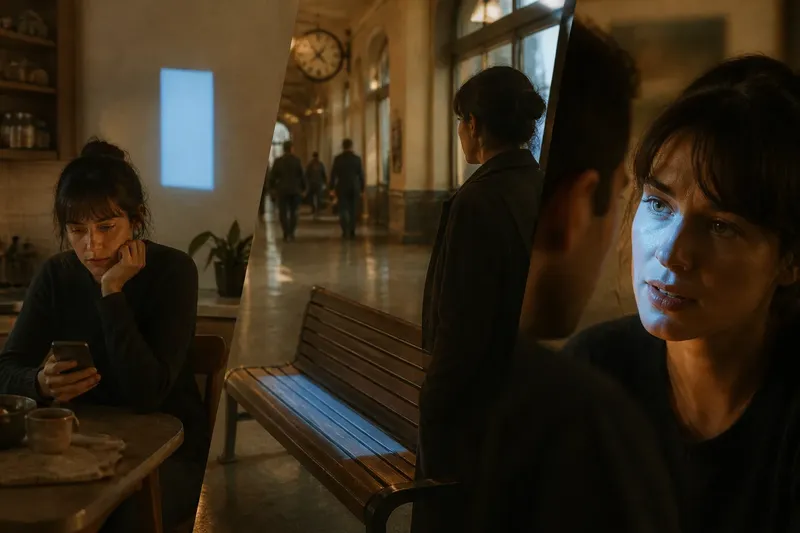
A blue rectangle of light lands on a kitchen wall, then turns up again in a station corridor and, near the end, on a character’s face. If you’re tracking a repeated image in a film, the useful question isn’t just “What does blue mean?” It’s “What has changed each time the image returns?”
Repetition invites attention, but it does not automatically announce a secret code. A visual echo may link scenes, shape a mood, or simply arise from a film’s locations and lighting. A careful viewing note keeps those possibilities open while giving you something concrete to compare.
What should you record at the first appearance?
Start with the image as it appears, before assigning it a meaning. In this invented, hypothetical walk-through, imagine a fictional film called Northbound. Its first blue rectangle is a patch of window light across a kitchen wall while Mara sits alone, listening to a message she has not yet answered.
Write down the visible particulars: the rectangle’s color, shape, position, surrounding objects, and the scene’s basic action. Note who is present and what the camera lets you see. Keep the record brief; you’re making a reference point, not reviewing the whole scene.
- Image: a sharp blue rectangle on a pale wall.
- Placement: behind Mara, outside her immediate focus.
- Context: a quiet kitchen and an unanswered message.
- Presentation: the light appears briefly while the scene stays with Mara.
That description does not claim the light represents loneliness, a choice, or anything else. It says what is available to observe. Think of it like keeping a ticket stub: it helps you recognize the moment later, but it doesn’t explain the entire trip.
How do later appearances vary?
In the imagined film, the blue rectangle returns in a station corridor. This time it falls across an empty bench, while Mara stands near the frame’s edge. The shape is similar, but its placement and company have changed; the scene also moves rather than lingering in the kitchen’s quiet stillness.
At a third appearance, the same cool rectangle crosses Mara’s cheek as she speaks to her brother. The image is less isolated now: a person carries it, and the conversation has replaced the unanswered message. Record those differences separately instead of treating each return as an identical signal.
A compact comparison can help:
- First: wall, kitchen, Mara alone, message unanswered.
- Second: bench, station, Mara at the edge, movement through the corridor.
- Third: Mara’s face, conversation underway, another person in the scene.
Notice both continuity and variation. The rectangle remains blue and sharply bounded, yet its relationship to Mara changes from background detail to an image that shares her space. That shift is more specific than a general claim that “blue symbolizes sadness,” and it leaves room for the film’s other evidence.
What does the final context add?
Near the ending of this invented film, Mara returns to the kitchen and answers the message while the blue rectangle rests on the wall again. The image has not transformed into a new object or vanished; what differs is Mara’s action and the scene’s place in the story. The final appearance makes the first one easier to reconsider.
Now compare the bookends. In the opening, Mara sits alone and does not answer. In the last kitchen scene, she responds. The repeated light can make that change visible without functioning as a code with a single correct translation. It may also preserve a visual connection between those scenes, helping the ending feel related to the beginning.
Ask what the final context contributes: Does the image arrive during a choice, after a consequence, or during an ordinary pause? Who is there? Has the camera made the image more prominent, or does it remain part of the setting? These questions anchor interpretation in the film’s sequence rather than in a symbol dictionary.
How can you read a repeated image without overclaiming?
Try separating three kinds of notes: what is visible, what changes, and what you think it might suggest. Keeping them distinct makes it easier to revise a reading when another appearance complicates it.
- Visible: the same blue rectangle appears in three settings.
- Changed: it moves from wall, to bench, to Mara’s face; the surrounding action changes too.
- Possible reading: its returns connect moments when Mara’s response to other people is changing.
Then look for ordinary explanations alongside interpretive ones. Perhaps the rectangles come from similar windows, recurring architecture, or a consistent lighting design. That does not make the pattern meaningless; it means the pattern may be doing more than one job, or may not carry a deliberate message at all.
In this imagined case, the initial notes support a modest observation: the blue shape recurs while Mara’s relation to communication shifts. They do not establish that the color itself has a fixed meaning or that every appearance was planted as a clue. A strong reading can stay provisional and still be useful.
Which questions help when you review your notes?
Does every return show the same image?
Compare shape, color, framing, and placement rather than relying on memory. A partial resemblance may matter differently from a precise visual repeat.
What changes around the image?
Check who is present, what action is underway, and whether the image shifts from background to foreground. Those surrounding details often give a recurrence its particular force.
Does the ending alter the first appearance?
Look back at the opening after seeing the final context. The first image may acquire a new association, though it does not have to become a hidden explanation.
Could a practical cause account for the pattern?
Consider repeated locations, windows, colors, or lighting choices before settling on symbolism. A practical source can coexist with an artistic effect, so note what the film supports without forcing a single answer.
What should your final note say?
For the hypothetical Northbound, a useful closing note might read: “The blue rectangle begins behind Mara during an unanswered message, returns in a station and during a conversation, then appears in the kitchen when she replies. Its placement and company change; the final scene makes the opening feel less settled.” That records a sequence and a response without presenting interpretation as fact.
When you track a repeated image in a film, let the last appearance sharpen your attention to the first, not erase what you actually saw. The most rewarding note may be a precise question—why this image, in this context, again?—rather than a tidy answer.