From Painted Backdrop to Built World: How to Read a Film Set
Learn how to read a film set, from painted backdrops to detailed environments, and tell what each kind of space asks you to notice.
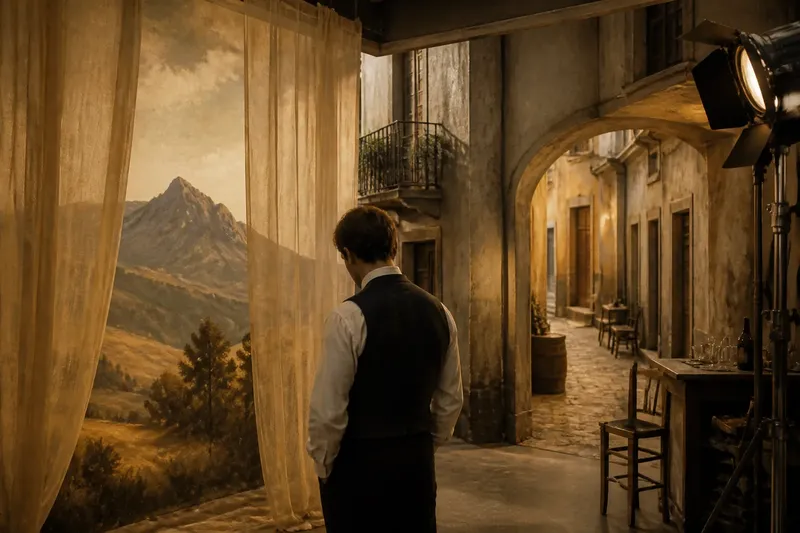
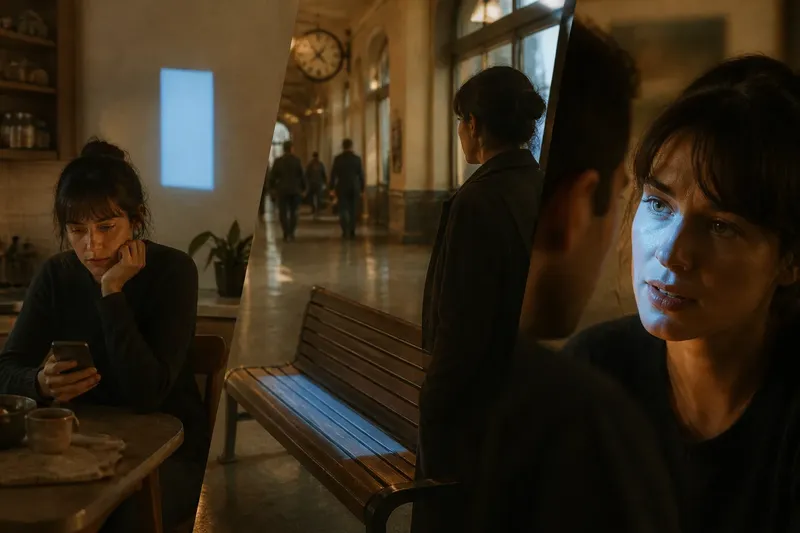
A painted mountain hangs behind a studio actor, its edge just visible beyond a curtain of gauze. In another scene, a corridor seems to continue around a corner, crowded with doorways and chipped plaster. Learning how to read a film set means noticing not only what a place represents, but how the image invites you to look at it.
Screen settings have moved from obviously composed backdrops toward environments that can appear richly continuous and lived in. The change is not a simple march from artificial to real. Each approach organizes attention differently: one may present a place like a framed image; another may invite your eye to wander through its details. When those approaches seem confusing, a few viewing problems are worth sorting out.
Why does a set look like a picture rather than a place?
A painted backdrop can make a setting legible at a glance. Distant hills, a city skyline, or a painted interior wall establish where a scene appears to happen without requiring every part of that world to be built. Its flatness can be part of the composition, not a flaw you need to catch.
This approach gives the frame a strong visual boundary. The scenery may sit behind performers like a picture behind glass, guiding attention toward faces, gestures, or a carefully staged arrangement. A theater stage offers a useful analogy: a painted room can establish an imaginary space while keeping its surface plainly present.
What to try: Look at the boundary between foreground and background. Does the scenery read as a fixed plane, with performers positioned in front of it? Notice whether the image asks you to take in the whole arrangement at once. If so, read the set as a composed view rather than as a room you could mentally walk through.
Why do some backgrounds feel shallow even when they look detailed?
Detail alone does not create depth. A backdrop may contain windows, clouds, or distant buildings, yet the scene can still feel shallow if its shapes stay on one plane or remain visually separate from the performers. The result may be a deliberate storybook, theatrical, or dreamlike effect.
Viewers sometimes assume a setting must feel convincing in the same way a real location does. That expectation can obscure what the film is doing. A deliberately flat background may turn the scene into a graphic composition, letting silhouettes and color blocks carry more weight than spatial continuity.
What to try: Track the overlap of shapes: does a person pass in front of scenery, or does the background remain like a separate panel? Then notice whether the scene’s visual emphasis depends on that separation. If the actors and backdrop seem arranged as distinct layers, treat the flatness as a cue to read the image’s design, not as a puzzle about how the set was made.
Why does a detailed set still fail to feel like a world?
A densely dressed room can offer shelves of bottles, patterned wallpaper, tools, and furniture, yet still feel like a display. The cause may be that its details do not support a clear sense of space: objects compete for attention, surfaces crowd together, or the frame gives no useful path for the eye to follow.
A built environment often asks you to read relationships among its parts. A doorway may frame another room; a table may anchor the foreground; a window may suggest distance beyond the walls. Those cues can make a place feel spatially connected, even when much of it lies outside the frame.
What to try: Start with the largest shapes, then move inward. Identify the room’s boundaries, the main route through it, and the objects that seem to belong to particular activities. If every prop grabs your attention equally, set aside individual decoration and look for the architecture that organizes it.
Why do elaborate environments sometimes feel harder to read?
More visible space can bring more visual information, but it does not automatically clarify a scene. A detailed environment may have several layers, open sightlines, and background activity. When your attention keeps drifting away from the central action, the issue may be that the image offers multiple plausible places to look.
That abundance can be meaningful. A busy street set may make the world seem to continue beyond the characters, while a sparsely dressed room may close attention around a private exchange. Ask what the environment lets you notice—and what it lets the frame keep distant—before deciding that a crowded image is merely distracting.
Say you encounter an invented scene in a station café, where a conversation unfolds beside a window overlooking the platform. If you find yourself watching the passing figures instead of the speakers, try first to identify the scene’s visual anchor, such as the table or the window frame. Then compare the background movement with the conversation: the expected observation is not a fixed answer, but whether the setting’s activity pulls attention outward or makes the conversation feel enclosed.
How should you read a setting that mixes flat and deep space?
A film can combine painted scenery, constructed walls, projected views, and real locations. The finished image need not reveal a neat boundary between them. Instead of trying to label every surface, notice how the different kinds of space work together inside the shot.
A painted skyline might supply a clean silhouette while a practical doorway gives performers a place to enter. A detailed foreground can meet a simplified distance without contradiction: the image may need one area to feel touchable and another to remain an emblem. The useful question is where the film concentrates spatial detail and what that choice helps the viewer read.
What to try: Follow the image from near to far. Notice which surfaces have edges, texture, or visible depth, and which read as broad shapes. Then consider whether the transition feels intentionally composed or simply leaves you unsure where the scene is located. Either response tells you something about how the setting is being presented.
What questions help you read film sets without guessing?
Does a painted backdrop mean the scene is less realistic?
Not necessarily. A backdrop can make a setting feel stylized, theatrical, or deliberately composed, but realism is only one possible aim. Consider whether the scene’s visual arrangement supports its mood and storytelling rather than judging it by how closely it resembles a location.
How can I tell whether a room is meant to feel continuous?
Look for connected sightlines, entrances, and overlapping areas that imply more space beyond the central view. If the frame presents the room as a single, bounded arrangement instead, the scene may be asking you to read it like a picture.
Why do I notice the scenery more than the characters?
The set may contain strong contrasts, unusual shapes, or movement that competes with the action. It may also be designed to make the environment itself prominent. Check whether your attention returns to a visual anchor or keeps wandering; that difference helps distinguish a purposeful emphasis from a crowded composition.
Should I try to identify how every set element was made?
Usually, no. Construction details can be interesting, but the more revealing question is what the visible space does for the scene. Follow the relationships among foreground, background, and action before speculating about specific production methods.
What should you try first when a setting feels confusing?
Use this order when the place is hard to read:
- Find the frame’s anchor. Choose the face, object, architectural edge, or patch of light that first gathers your attention.
- Separate near from far. Notice which shapes overlap and which remain behind the action as a broad plane.
- Trace the implied route. Look for doors, corridors, windows, or gaps that suggest where a person could move next.
- Sort structure from decoration. Identify the walls and boundaries first, then see which furnishings and surface details support them.
- Ask what the setting emphasizes. Decide whether it presents a composed image, a navigable environment, or a mixture of both.
These are viewing prompts, not rules for assigning a set to one historical category. The same film can make a room feel like a flat stage in one shot and a deep, inhabited space in another, depending on framing and action.
When you return to a scene, hold on to one specific question: where does the frame invite your eye to stop, and where does it encourage you to travel? That small distinction makes it easier to read a painted backdrop, a crowded interior, or a carefully layered world on its own terms.